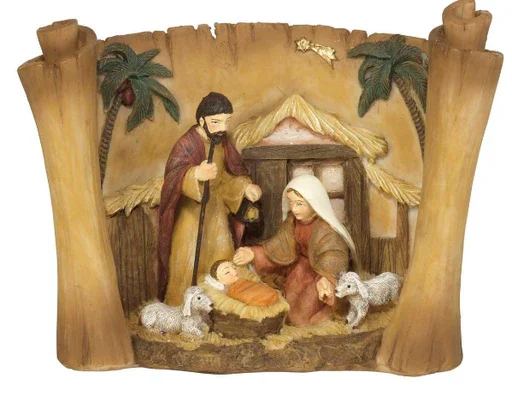
I love nativity scenes. Last year, I was very happy when a friend gifted me a lovely new set of a nativity scene. It features the baby, with his mother Mary, and Joseph, his stepfather. This particular nativity set does not include the shepherds or the Wise Men; instead, it features just two lambs. It is lovely. The whole set is lovely.
Nativity scenes are ubiquitous at Christmas, along with other Christmas-related symbols and paraphernalia: the star, the Wise Men’s gifts, the lights, the carols, and so on. All these things are lovely, and they help us to feel good about Christmas.
But all of these are not entirely harmless. There is a subtle but real danger – probably not arising from these symbols and images themselves, but from the tendency of the human heart toward superficiality – that Christmas can become too sentimental, perhaps superficial, too small. We sentimentally gaze at a nativity scene, we marvel at the baby in the manger, but never pause long enough to ask the deeper and more unsettling question: Why did God become human at all? And even more disturbingly: Why would the God of the universe choose not only to be born, but to suffer, to be rejected, and to die?
It is very possible – and in fact very real – that one can celebrate Christmas and yet never actually grasp its true meaning or significance. And one can never truly grasp the meaning and significance of Christmas without seeing it as part of the bigger story of God becoming human. In this larger picture, the birth of baby Jesus is clearly one part of a whole – one chapter of a book, as it were. That whole includes the fact that Jesus grew into a fully adult man, who lived his entire life in faithful obedience to his mission of saving the world, and that the central acts of that mission were his suffering, death, and resurrection.
Years of biblical and theological study have meant that I am able to see and appreciate more deeply and clearly the meaning and significance of God becoming human – or, to use a technical term, the Incarnation. Every year, at every Christmas, I feel a divine invitation from the Lord to ponder more deeply the reality and significance of His becoming a man. And this Christmas, I felt led to do so with the help of Athanasius, through his writing On the Incarnation. I have long been aware of this book, but it is only this time that I have had both the time and the resolve to read it devotionally.
Athanasius, who was born in 293 and died in 373 in Alexandria, Egypt, was a theologian, a bishop, and an Egyptian national leader. He was the chief defender of Christian orthodoxy in the fourth-century battle against Arianism – the heresy that taught that Jesus Christ was not truly God, but merely a creature of God the Father. Aside from On the Incarnation, his other important writings include The Life of St Anthony and The Four Orations Against the Arians.
On the Incarnation remains one of the clearest and most beautiful reflections ever written on the mystery of Christmas. It is a blessing – readily available to all who are willing to read it – that this book has been translated into English and is freely accessible on the internet. This particular link will take you to a free PDF copy of the book: https://www.monergism.com/thethreshold/sdg/athanasius/On%20the%20Incarnation%20-%20Athanasius.pdf
I would like to take you on a journey with me through the wisdom of one of the great teachers of the early Church.
Athanasius begins where Scripture itself begins: with creation. Humanity was created by God out of love, made in God’s image, and created to enjoy life and fellowship with God. We were not made for death or sin or corruption; we were made to live in eternal fellowship with the living God.
But something went terribly wrong. Human beings turned away from God; they rebelled against him. Athanasius describes sin not merely as guilt, but as corruption – a movement away from life and toward decay, dissolution, and death. To reject the source of life is, inevitably, to move toward non-life. Here is a striking passage from him:
“For God had made man, and willed that he should abide in incorruption; but men, having despised and rejected the contemplation of God, and devised and contrived evil for themselves, received the condemnation of death with which they had been threatened; and from thenceforth no longer remained as they were made, but were being corrupted according to their devices.”
We see this corruption everywhere: in our bodies, which weaken and fail; in our relationships, which fracture and wound; in our societies, which promise progress but remain haunted by violence and injustice; and most painfully, in death itself – the great enemy that spares no one.
At this point, one may ask: Could God not simply forgive humanity and start again? Athanasius’s answer is striking. God’s problem, he says, was not a lack of mercy, but a commitment to his own character. God is both good and truthful. On the one hand, God’s goodness would not allow his precious creation to perish entirely. It would be unthinkable for the God who lovingly made humanity to abandon it to decay and death. On the other hand, God had made it clear that turning away from him – the source of life – would result in death. For God simply to ignore that word would be to deny his own truthfulness.
So how could God remain true to himself – both good and truthful – while rescuing humanity from corruption and death? Athanasius’s answer is breathtaking: God himself must come.
This is the heart of Christmas. God did not remain distant. He did not ultimately send an angel or a prophet or a priest to solve the problem from the outside. Instead, he entered the human condition from the inside. “The Word became flesh and dwelt among us” (John 1:14).
Athanasius insists that this was not a divine illusion or a temporary disguise. God truly became human. He took on a real body, a real human life, subject to weakness, suffering, and mortality. Why? Because only a human could truly represent humanity. And only God could truly defeat death. In Jesus Christ, these two necessities meet. He is fully human, able to stand in our place. He is fully divine, able to save, restore, heal, and renew what had been corrupted.
For Athanasius, then, the Incarnation is not God paying us a visit; it is God binding himself permanently to our humanity.
And it does not stop there. Athanasius goes on to make what is perhaps his most unsettling and most wondrous claim: that the Son of God became human in order to die. The cross, then, was not an unfortunate accident or a tragic misunderstanding. From the very beginning, God’s saving purpose included the cross. Christmas, therefore, cannot be separated from Good Friday.
And yet this is not a story of despair. Athanasius affirms strongly the reality of Christ’s victory over death in his resurrection.
So, what does all this mean for us here and now?
Many things – but particularly this: Christmas is not simply something to admire, as one admires a piece of artwork. It is something to receive. The God who has come to save us invites us to turn to him – to trust him, to worship him, and to follow him.
The Jesus who was born on Christmas Day later grew into adulthood, and during his public ministry he taught openly. One of the most wonderful invitations he ever uttered – an invitation extended to all of us – is this:
“Come to me, all you who are weary and burdened, and I will give you rest” (Matthew 11:28).
As we celebrate Christmas, may we ponder deeply not only the wonder of the birth of the baby, but also the costliness of the Incarnation. The child in the manger is the Lord of glory. This is the wonder of Christ – the wonder that never ends: God became human, so that fallen humanity might be restored to life with God. Or, in the words of C. S. Lewis, “The Son of God became a man to enable men to become sons of God.”
May this truth deepen our joy, strengthen our faith, and draw our hearts in worship this Christmas and always.